Validation 7 min read Stat-checked

You're Not Alone - Half Of All Men Are Below Average

The global average erect penis length is 5.5 inches. By definition, half the male population sits at or below that number. If you've spent years feeling like the outlier in every locker room, dating app, and bedroom story you've ever heard - the math has been quietly on your side the entire time.

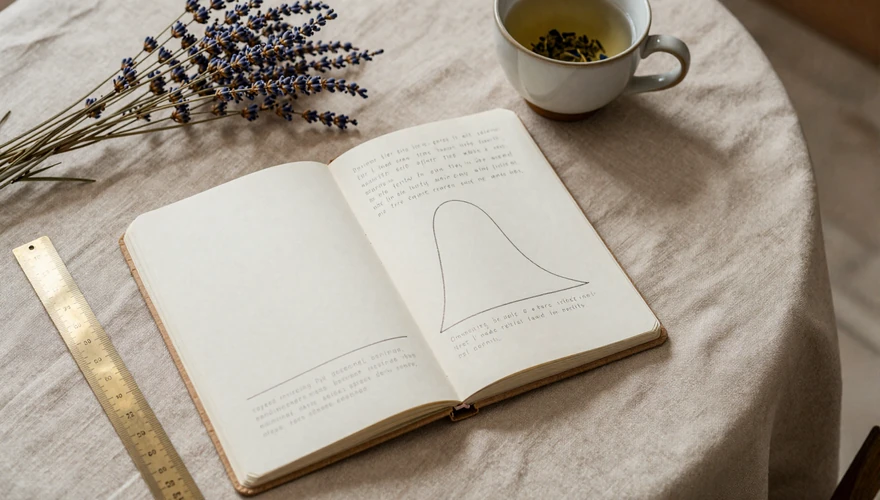
Warm linen desk with an open research journal, ruler, and tea cup illustrating average penis size statistics on a body-positive dating blog
Quick Takeaway

The 30-second version

The global average erect penis is roughly 5.5 inches (14 cm). Half of all men measure at or below that number - that's the definition of an average. Self-reported sizes are inflated by about one inch on average, which is why "everyone seems bigger than me" feels true and statistically isn't. The community of people who prefer, accept, or are simply neutral about smaller partners is large enough to power entire specialty dating sites like BeyondSize. You are the median, not the exception.

By the numbers

The Numbers That Reframe Everything

Four citable statistics that, taken together, demolish the locker-room story most men have been telling themselves since middle school.

5.5"
Global average erect length
≈ 14 cm - King & Veale meta-analysis, BJU International
50%
Of men at or below average
By definition of statistical median
< 3.5"
Threshold for micropenis
Approx. 9 cm - clinical definition
+1"
Typical self-report inflation
Self-measured vs. clinically measured studies

About the micropenis category

A micropenis is clinically defined as an erect length under 3.5 inches (9 cm). It is rarer than the public imagination suggests - and specifically welcomed at BeyondSize, where members in this range consistently report finding partners after years of writing themselves off on mainstream apps. Smaller does not mean alone; it means a smaller pool that happens to be highly motivated.

What 5.5 Inches Actually Means

The average isn't a target - it's the middle of a curve. When researchers measure erect length across tens of thousands of men, the results form a familiar bell shape: a fat middle where most men cluster, and skinny tails on either end. The 5.5-inch figure represents the peak of that curve, not the floor of acceptability.

Here's where it gets interesting: the bell is narrower than people assume. Roughly two-thirds of men measure between 4.5 and 6.5 inches. The men describing themselves as "huge" in casual conversation are almost always sitting in that same band - they've just rounded up. A 6.2-inch man hears himself say "about seven" and an entire generation of teenagers writes themselves a story about being below average. The story was wrong from the start.

Range (erect) Approx. share of men What it actually means
Under 3.5" ~1-2% Micropenis range - clinically defined, specifically welcomed on niche platforms
3.5" - 4.5" ~12-15% Below average - the "small" most men actually mean when they use the word
4.5" - 5.5" ~35% Average band, lower half - statistically the most common range
5.5" - 6.5" ~35% Average band, upper half - what self-reporters round up to "seven"
Over 6.5" ~12-15% Above average - far rarer than locker-room conversation suggests

Why does this matter in practical dating terms? Because the men loudest about size - in group chats, in dating-app bios, in the bragging that filters into every conversation - are statistically extremely unlikely to be telling the truth. The "average" you've been comparing yourself to was never the real average. It was a chorus of overestimates dressed up as data.

"I spent fifteen years believing I was small. I'm 5.1 inches. I'm the average. The average has been gaslit by the loudest 15% for an entire generation." - Dean, 38, Chicago · BeyondSize member
Myth check

Three Myths Specialty Dating Sites Quietly Disprove

Every day BeyondSize is open is another data point against the stories below. The platform exists; the members are real; the matches happen. That's the empirical answer to a lifetime of locker-room fiction.

Myth 1 - "No one actually prefers smaller."

  • Repeated in bro-culture, TV jokes, and entire decades of late-night comedy.
  • Treats preference as a single homogeneous market, which no other body trait survives.
  • Ignores comfort, sensation, and aesthetic preferences that vary widely.

Fact 1 - Preference is a spectrum.

  • Many partners report active preference for smaller for reasons of comfort, oral pleasure, and pelvic anatomy.
  • Far more report neutrality - size simply isn't in their top-ten attraction criteria.
  • Specialty platforms surface both groups at scale. Read the size preference deep-dive for the why.

Myth 2 - "Niche dating sites are tiny and fake."

  • Assumes a small niche means an empty platform.
  • Ignores that body-positive dating has been covered by hundreds of media outlets - TV, radio, print, and online - since the late 2010s.

Fact 2 - The community is well-documented.

  • Body-positive dating platforms have appeared in dating-news roundups, dating-advice columns, and mainstream lifestyle press for years.
  • Verification systems on modern niche sites filter for active, real members rather than the bot-heavy adult-adjacent reputation older sites earned.

Myth 3 - "Being below average means staying single."

  • Conflates size with desirability - a connection no serious attraction research supports.
  • Treats mainstream apps as the entire dating market, which they aren't.

Fact 3 - Channel choice matters more than size.

  • Men who switch from mainstream to specialty platforms report dramatically lower disclosure anxiety. See disclosure anxiety.
  • Confidence - the actual top-ten attraction trait - grows fastest when the dating pool is already informed.

How Big The Body-Positive Dating Community Really Is

The bottom line: this isn't a fringe community. Body-positive and size-inclusive dating platforms have been covered by hundreds of media outlets over the past decade - television segments, radio interviews, print features, and online roundups in everything from dating-news verticals to mainstream lifestyle press. When Dinky One launched as one of the first dedicated platforms, the coverage came in waves: dating advice columns, micropenis-awareness pieces, body-positivity features, and ongoing dating-news reviews. The story kept getting picked up because the audience kept growing.

Featured in Dating News Dating Advice columns Body-positivity press Radio + TV segments Hundreds of outlets

What does this mean in practice? It means the loneliness many men describe - the sense of being the only one - is socially constructed by silence, not by demographics. The numbers have always been there; the platforms that surface those numbers are what's new. BeyondSize sits in this lineage of body-positive dating products, designed specifically so that two truths can coexist on the same homepage: you are statistically the median, and there are partners actively looking for what you actually have.

The community is also visibly diverse. The Club hosts members across orientations, relationship structures, and ages - single, divorced, partnered-and-open, queer, straight, trans, and non-binary. Body-positivity is the throughline; everything else varies. That breadth is itself a data point: a tiny, fake, or marginal community could not sustain that range.

In their words

Members On Realizing They Weren't Alone

Two BeyondSize members on the specific moment the statistics stopped being abstract.

I read the 5.5-inch figure for the tenth time and finally believed it. I am exactly average and I had spent twenty years apologizing for it. The first profile I wrote after that landed three matches in a week.

Andre, BeyondSize member from Atlanta
Andre, 36 Atlanta, GA
Verified member

The thing that broke the spell was meeting another member in the Club forums who measured exactly what I do. He had a partner. He had been dating for three years. That was the proof I needed.

Wes, BeyondSize member from Portland
Wes, 41 Portland, OR
Verified member

Frequently Asked Questions

What is the actual average erect penis size?

The global average erect penis length is approximately 5.5 inches (14 cm), based on meta-analyses of studies using clinically measured rather than self-reported data. Average flaccid length is closer to 3.6 inches. Roughly two-thirds of men sit between 4.5 and 6.5 inches erect, which means the "average" is a fat middle, not a sharp cutoff.

Why do online sources disagree about average size?

Two reasons: self-reported studies inflate the average by about an inch because men round up, and small-sample studies in single regions produce wider variation than global meta-analyses. The 5.5-inch figure comes from large, clinically-measured datasets and is the most defensible number to cite. Anything significantly higher is usually self-reported.

What counts as a micropenis?

A micropenis is clinically defined as an erect penis less than 3.5 inches (9 cm). It is rarer than casual conversation suggests - roughly one to two percent of the adult male population. BeyondSize specifically welcomes members in this range, who often report being written off entirely by mainstream apps before joining a specialty platform.

Do specialty dating sites actually have enough members to work?

Yes. Body-positive and size-inclusive dating platforms have been covered by hundreds of media outlets - including dating-news verticals, dating-advice columns, mainstream lifestyle press, radio, and TV - driving sustained membership growth over the past decade. The community is well-documented and the platforms are active enough to produce regular matches.

Is there a dating app for cerebral palsy or other specific conditions?

There are dating platforms and communities serving many specific groups, including disability-focused sites and inclusive mainstream apps with accessibility features. For size-specific dating, BeyondSize and similar specialty sites are the most direct fit. Members with disabilities are welcomed on the same body-positive terms as every other member.

Will I really find someone who prefers a smaller partner?

Preference for smaller partners is well-documented across reasons including comfort, sensation, oral focus, and aesthetic taste. An even larger group is neutral on size - meaning it isn't a factor in their attraction at all. On a specialty platform both groups self-select in, which is why matches form faster than on mainstream apps where size is hidden until disclosure. Read the size preference guide for the full breakdown.

How does joining a community help if I already know the statistics?

Statistics convince the brain; community convinces the nervous system. Seeing other members at your size, in active conversations, with partners, and contributing to forums turns abstract numbers into lived proof. Most members report that the loneliness eases within the first two weeks of being in The Club, well before their first date.

Keep reading

Keep Reading

Two articles that pair naturally with the validation question - one on confidence, one on why some partners actively prefer smaller.

Relaxed man laughing on a rooftop at golden hour, illustrating dating with confidence and self-acceptance Confidence

Dating With Confidence: The Practical Guide

Seven rehearsable tips, mindset shifts, and partner-communication scripts that turn settled self-knowledge into easy first dates. Member-tested over four to six weeks.

Read the confidence guide
Two women laughing together on a linen sofa, illustrating partners who prefer smaller in a body-positive dating context Preference

Why Some Partners Actually Prefer Smaller

Physical comfort, emotional dynamics, oral focus, and aesthetic preference - the actual reasons partners self-select toward smaller, in their own words and the research.

Read the preference guide

Or jump to the Men's category for verified partners, browse The Club for community forums, or head back to the BeyondSize homepage.

Find Your People

The statistics are on your side. The community is already here. The only thing missing is a profile.

Email-only signup · Photos optional · One-click delete · No credit card